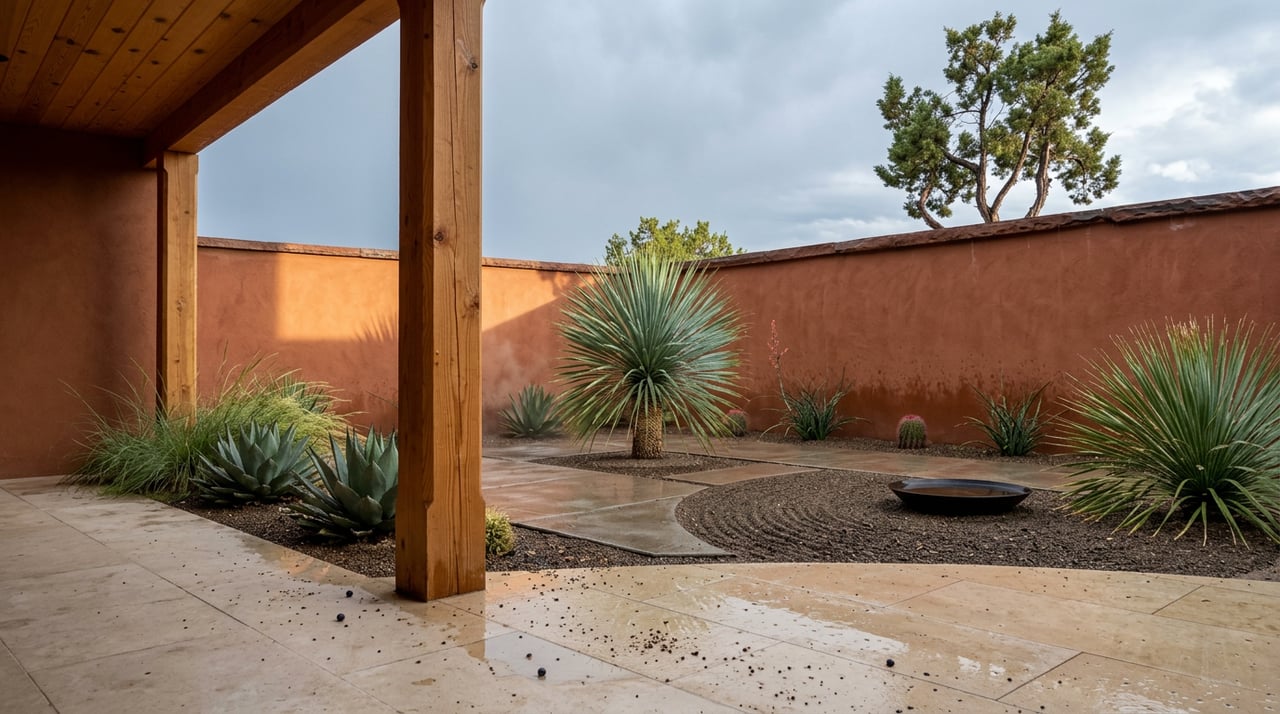
By the second week of July, the sky here starts keeping its own appointments. Clear at seven. Hot and bright by ten. Thunderheads stacking over the Mogollon Rim by two. A hard, twenty-minute storm somewhere between three and five that drops the temperature thirty degrees and leaves the sandstone glowing wet. Then a long, cool evening that goes until the stars come out.
If you have lived here through more than one summer, you already know the trick: you do not fight this schedule, you run your day inside it. What the visitor guides describe as an inconvenient season is, for residents, the most usable stretch of the calendar. The trails clear out, the restaurant reservations get easier, and the cultural calendar quietly turns out to be busier in July than in April. You just have to read it correctly.
The clock the monsoon sets
The relevant numbers, if you want to plan around them, are these: July highs run near 95 to 96 degrees, monsoon moisture typically arrives in the window of July 15 to 20, and the month averages between roughly 1.6 and 2.3 inches of rain, almost all of it delivered in short, intense afternoon cells. When one of those cells opens up, the ambient temperature can fall twenty to thirty degrees in about half an hour.
That is not a weather forecast. That is a scheduling constraint. It means the four hours between sunrise and about ten in the morning are the only reliably cool, reliably dry, reliably safe hours to be on exposed rock. Everything else in the day has to be built around what you can do when the sky is either an oven or a threat.
What the morning is for
Locals treat July mornings the way people in other climates treat cool weekend afternoons. Bell Rock, the Courthouse Butte Loop, and West Fork are all doable before the heat sets in if you are on the trail by six. Red Rock State Park runs an 8:30 a.m. guided nature hike that has been folded into Arizona's statewide Outdoors250 programming for the country's 250th anniversary, and it is one of the few interpreted walks in the area that suits a resident who has already done the postcard trails a dozen times.
The parking, which is the actual limiting factor at places like the Devil's Bridge trailhead the rest of the year, becomes a non-issue in July after the holiday weekend. If your out-of-town guests want the marquee hikes, this is the month to take them without listening to a shuttle bus lecture on the way in.
By ten thirty, you should be somewhere with a roof.
Midday belongs indoors, and there is more there than you think
The default midday move is a spa or a gallery crawl through Tlaquepaque, and both are perfectly good. But the more interesting play in July 2026 is the Mary D. Fisher Theatre, where the Sedona International Film Festival is running summer premieres well outside its usual February window. The last week of June and first week of July brought Sedona and Northern Arizona premieres of Pressure, Ethan Bloom, and The Pianist's Choice, and the summer premiere schedule tends to keep rolling through the monsoon months. A two o'clock screening is functionally the same as an afternoon at the movies in a hotter city, except the theatre is fifteen minutes from your driveway and the films are not the studio slate.
The Sedona Hummingbird Festival at the Sedona Performing Arts Center is the other reliably-indoor July anchor, and it is one of the few local events where a longtime resident can still learn something. The lectures on rufous migration and the garden tours during monsoon greening genuinely change how you look at your own yard for the rest of the summer.
If none of that appeals, the honest fallback is that the galleries and courtyards inside Tlaquepaque hold their temperature better than most private houses. It is a working midday shelter that happens to be beautiful.
The three-to-five window is a photograph, not a problem
This is the hour that separates people who live here from people visiting. When the first cell builds over the rim, you do not go inside. You go up. Airport Mesa and the Schnebly Hill overlook are the two positions that consistently produce the storm-light frames you see in the coffee-table books, and they are almost empty on a Tuesday afternoon in late July because most visitors are back at their resorts waiting for the rain to stop.
The rain almost never lasts more than half an hour in one place. What lasts is the light afterwards. The red rock is a different color wet than dry, and the twenty minutes between the last of the storm and full sunset is the reason a lot of us moved here.
A word of practical caution that stops being obvious once you have lived here a while: the washes fill fast. West Fork, Oak Creek Canyon narrows, and anything downstream of a burn scar can flash without visible rain overhead. This is not a season to improvise in a slot.
Evenings run later than the guidebooks say
The tourist-facing write-ups will tell you Sedona kitchens close early and most of the town is quiet by nine. That is true of the dining rooms, which almost universally stop seating by nine even on weekends. It is not true of the cultural calendar, which in July is denser after dark than at almost any other time of year.
Three specifics worth putting on the household whiteboard:
El Rincón at Tlaquepaque runs Flamenco in the Courtyard every Sunday, Monday, and Tuesday evening through the summer in the Patio de Las Campanas. It is the kind of standing weekly event that residents forget is available to them until the fifth time a houseguest asks what to do that night.
The Sedona International Film Festival's Movies on the Move series is partnering with the Village of Oak Creek this summer for outdoor screenings, which is a rare case of Uptown culture pushing south rather than the other way around. And the sound bath, tai chi, and qigong programming on the chamber's community calendar runs a steady rotation of Monday, Friday, Saturday, and Sunday sessions that most of us drive past every day without registering.
The practical dinner move follows from all of this. Book at seven, not eight. That leaves you enough kitchen time to eat well, enough evening to catch a screening or a courtyard set afterward, and it lands you home before the servers at Mariposa or Cress start closing the room around you.
The July 4 exception, and why it does not break the rule
The one day the resident rhythm inverts is Independence Day. Sedona does not host fireworks because of its International Dark Sky Community designation, and the substitute is the Sedona Summer Splash at the Sedona Community Pool, 570 Posse Ground Road, from noon to four on July 4. It is free, it is loud, and it is one of the few days a year when the middle of the day is where you want to be rather than where you are hiding from.
If a pool party is not your speed, the Sedona Elks Lodge on Airport Road usually runs a public BBQ from eleven to three on the holiday, which is the closest thing this town has to a genuinely mixed year-round-resident gathering. The view down the valley from Airport Mesa handles the rest of the entertainment budget.
The evening version, if you skip the drive to the Cottonwood fireworks, is the resort BBQ and stargazing circuit anchored by Enchantment in Boynton Canyon. On a 250th-anniversary July 4 that happens to fall on a Saturday, the argument for staying in Sedona and pointing a telescope at Saturn rather than driving south for pyrotechnics is stronger than usual.
The exception proves the rule. Every other day in July, the town is best read as a morning-and-evening place with a long indoor pause in the middle. On the fourth, it is a midday place with a quiet dark evening. Both work. Neither of them is what the season looks like from the outside.
What this actually changes
The reason to be precise about all of this is that July is the month when Sedona stops belonging to the calendar its brochures print and starts running on the schedule its residents keep. Trails at dawn. A theatre or a courtyard at two. A parapet or an overlook at four. A seven o'clock reservation. A dark sky at ten.
Once you see it that way, the season stops being something to survive and starts being the reason a lot of us bought here to begin with.
If you own a home in Sedona and are thinking about how the way you actually use it, and the neighborhoods around it, should shape a future sale, a purchase, or a second-home decision, Liz Adams at Oak Creek Realty offers consultations built around that kind of local specificity. Schedule a free consultation when the timing suits you.